
Initial awards under DHS’s $500 million Counter-UAS Grant Program beat FEMA’s own timeline, leveraging new SAFER SKIES authorities to harden World Cup 2026 and America 250 events while seeding a broader state and local drone defense market.
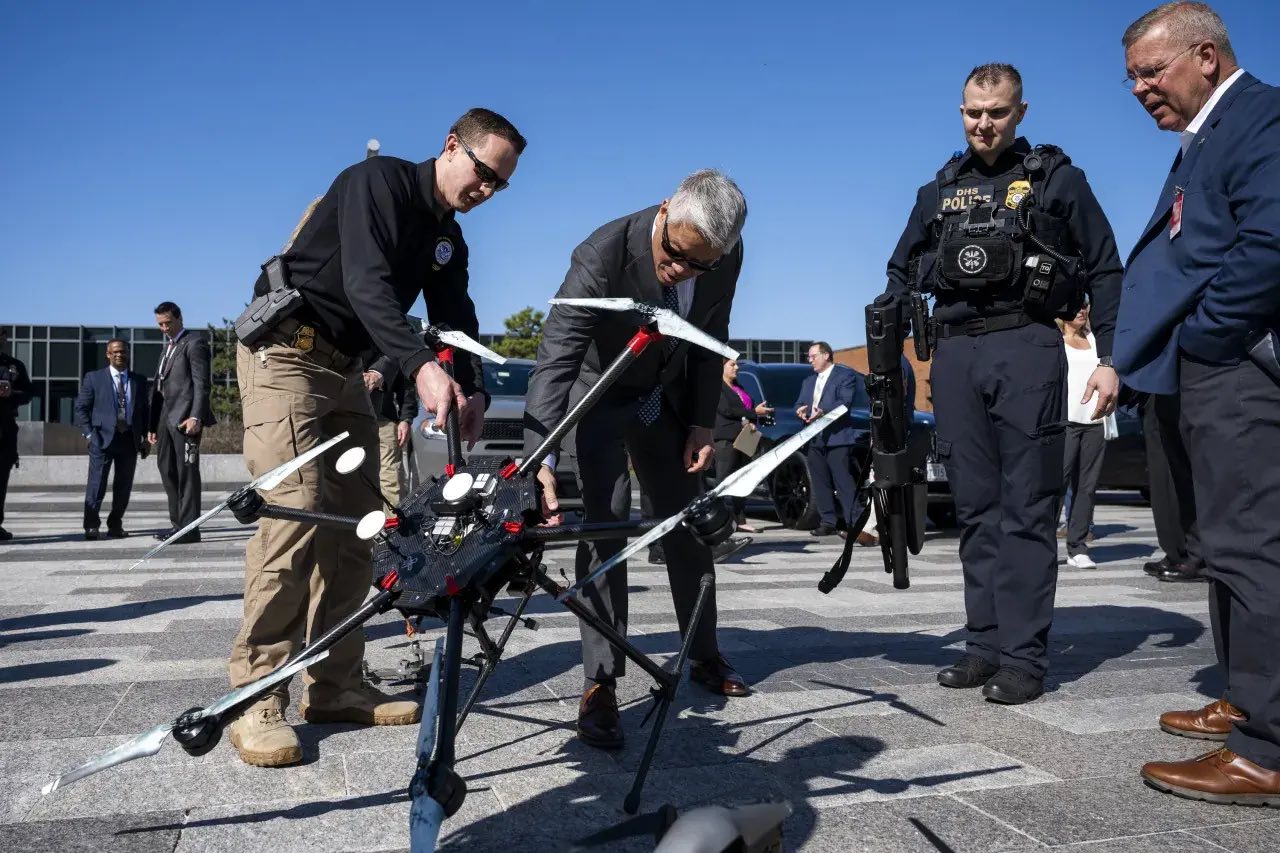
When FEMA released the first Notice of Funding Opportunity (NOFO) for its new $500 million Counter-Unmanned Aircraft Systems (C-UAS) Grant Program in late October, the document read like a blueprint for how Washington intends to buy and govern domestic drone defense over the next several years. As reported in November, the program was framed as a World Cup–driven initiative with national ambitions: $250 million for FIFA World Cup 2026 host states and the National Capital Region (NCR) in Fiscal Year 2026, followed by another $250 million to all 56 states and territories in FY 2027.
Now FEMA has moved from blueprint to awards faster than expected.
On December 30, the agency announced it has awarded the first $250 million to the 11 states hosting FIFA World Cup 2026 matches and to the NCR through the new C-UAS Grant Program. Recipients can use the money to “detect, identify, track, or mitigate” unmanned aircraft systems threatening major events and critical infrastructure. FEMA calls it the fastest non-disaster grant program in its history, with awards issued just 25 days after the application deadline.
“We knew we needed to act quickly to keep the World Cup safe from the rising threat of unmanned aircraft systems and that’s exactly what we did,” FEMA Acting Administrator Karen S. Evans said in the announcement, pointing to the agency’s “laser-focus on cutting red tape” and getting resources into the hands of law enforcement.
From NOFO Timeline to “Fastest Non-Disaster Award”
The speed is notable because the original NOFO guidance anticipated a much longer process. FEMA’s October funding bulletin projected a December 5, 2025 application deadline, a January 30, 2026 selection date and awards issued no later than February 27, 2026.
By obligating the full FY 2026 tranche before year-end 2025, FEMA has effectively accelerated that schedule by nearly two months. For state administrative agencies (SAAs) and local subrecipients, that means more time to finalize procurements, complete training and integrate C-UAS capabilities before the World Cup kicks off in mid-2026.
The program’s structure remains exactly as outlined in the NOFO:
- Phase 1 (FY 2026) – Up to $250 million limited to SAAs in the 11 World Cup host states plus the NCR, which is also preparing for high-profile America 250 celebrations.
- Phase 2 (FY 2027) – Up to $250 million expanded to all 56 states and territories, with minimum allocations and risk-based competitive funds aimed at building “nationwide detection and response capabilities.”
The period of performance, already back-dated to July 4, 2025 and running through September 30, 2028, gives recipients a multi-year runway to deploy and refine systems.
World Cup as Catalyst, National Architecture as End State
The December awards underscore what the NOFO telegraphed: the FIFA World Cup is the immediate catalyst, but the underlying objective is a lasting, layered C-UAS architecture in U.S. cities and critical infrastructure hubs.
Every FIFA match in the United States has been rated a Special Event Assessment Rating (SEAR) 1 or 2, with some likely to be elevated to National Special Security Event (NSSE) status. America 250 events in the NCR carry similar designations. The C-UAS Grant Program is designed to give state and local partners the sensor coverage, command-and-control integration and limited mitigation tools needed to handle small-UAS threats without over-reliance on federal “fly-in” assets.
In that sense, the December announcement is less a surprise than a confirmation that the Department of Homeland Security (DHS) is willing to bend its own administrative timelines to meet a hard operational date on the calendar.
Tied to SAFER SKIES and Airspace Sovereignty
The new awards also sit squarely within the Trump Administration’s broader airspace security agenda. FEMA explicitly links the C-UAS Grant Program to the Executive Order on Restoring American Airspace Sovereignty, signed in June 2025, and to the recently enacted SAFER SKIES Act, which expands counter-drone authorities for state and local law enforcement under a framework of federal training, certification and reporting requirements.
That matters because the NOFO draws bright lines between what the grants can and cannot fund:
- Money is aimed at detection, identification, monitoring, tracking and—where legally authorized—mitigation of drones (DIMT-M), not weapons or experimental tech.
- Only law enforcement or correctional agencies can receive mitigation tools, and only if their personnel are trained at, or enrolled in, the FBI’s National Counter-UAS Training Center.
- Applicants seeking mitigation must commit to privacy protections, FAA/FCC compliance, operational coordination with DHS/DOJ and support to Joint Counterterrorism Task Forces.
The SAFER SKIES Act gives those conditions more teeth by codifying how state and local agencies can detect and, in limited circumstances, defeat unsafe or malicious drones, while imposing accountability measures such as mandatory incident reporting.
What Changes Now for Industry and SLTT Agencies
For unmanned and counter-UAS vendors, integrators and service providers, the NOFO was already a signal that domestic C-UAS spending was about to scale. The new announcement confirms that signal in a more concrete way: the first $250 million is now in the hands of SAAs, with a pass-through requirement that pushes 97% of funds down to local subrecipients.
A few implications stand out:
- Procurement conversations move from hypothetical to funded. Vendors that helped shape investment justifications now need to move quickly with SAAs and local agencies to convert those plans into purchase orders, site surveys and integration work.
- Data and performance reporting will shape future buys. FEMA’s metrics—tracking system usage hours, detections, unique UAS events and investigations launched—mean agencies will need solutions that produce defensible numbers, not just radar plots or RF hits.
- Training and legal guardrails remain gating factors. Even with money on the table, agencies pursuing mitigation tools will be constrained by NCUTC training throughput, approval of specific technologies under SAFER SKIES and local policies around privacy and civil liberties.
For state and local drone programs that depend on open airspace and public trust, that last point cuts both ways. Clearer rules for counter-drone operations can reduce legal uncertainty, but aggressive or poorly governed C-UAS deployments could still generate pushback from operators and civil liberties advocates.
A Preview of the FY 2027 Nationwide Build-Out
While the first tranche is tightly focused on World Cup and America 250 venues, FEMA’s announcement reiterates that the second $250 million will be distributed in FY 2027 “to all U.S. states and territories with an expanded focus on building detection and response capacity nationwide.”
Between now and then, DHS and FEMA will be watching how this first wave of awards performs:
- Do DIMT-M systems materially improve security around SEAR 1/2 and NSSE events?
- Are local agencies able to integrate C-UAS feeds into existing command centers and fusion cells?
- Do the performance metrics justify additional appropriations or changes to program design?
The December decision to move $250 million out the door early signals that, at least for now, the Administration is betting heavily that the answer to those questions will be yes.
For the C-UAS ecosystem, the message is clear and consistent: the era of pilots and demonstrations is giving way to an era of operational deployment at scale, under tight legal, training and data-reporting regimes, and now on a compressed timeline driven by the biggest sporting event in U.S. history.