
Experts from across the federal government have kicked off a three-year campaign to tighten America’s defenses against small drones, underscoring just how critical Counter-UAS has become as a homeland security and joint warfighting challenge.
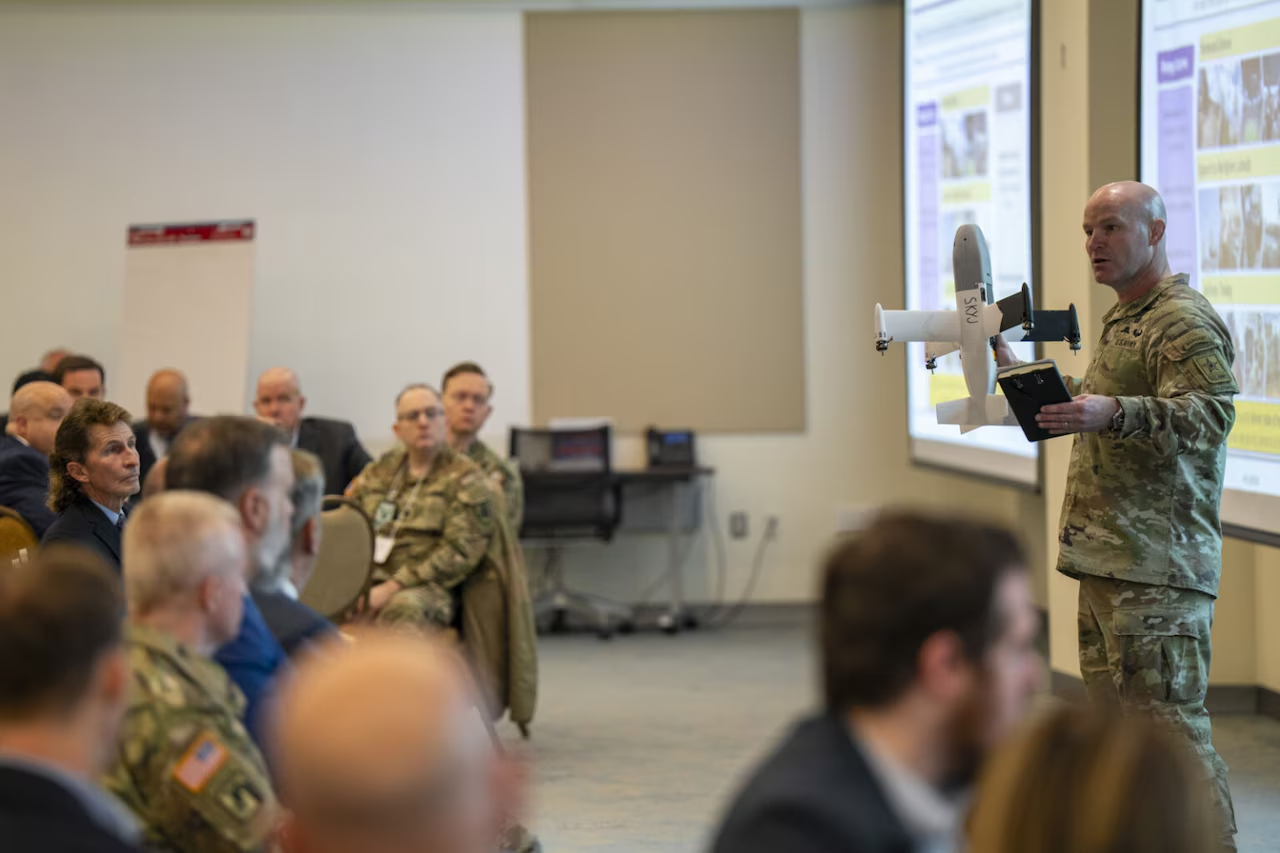
Over 180 experts from across the federal government gathered at the Mark Center in Alexandria, Virginia, on November 25 for what amounts to a reset of how Washington tackles small drone threats. The event was the inaugural interagency summit of Joint Interagency Task Force 401 (JIATF 401), a new, Army-led organization charged with delivering counter-small UAS capabilities to warfighters and “keep the skies over America safe from dangerous drones” over the next three years.
The summit brought together representatives from the Department of Defense, Department of Homeland Security, FBI, Department of Transportation, FAA and roughly 50 federal entities with equities in counter-UAS. It signals that counter-drone is no longer a niche mission: it’s being treated as a mainstream, whole-of-government problem that spans homeland security, border protection, air defense and major events.
From JCO to JIATF 401: speed over process
JIATF 401 traces back to an August 2025 memo directing the Army to stand up a new task force with broader authorities and a clear mandate to move faster than traditional acquisition pathways.
“My priorities for transformation and acquisition reform include improving [counter-small unmanned aircraft systems] mobility and affordability and integrating capabilities into warfighter formations,” Secretary Hegseth wrote in that memo, which tasked Army Secretary Dan Driscoll with creating the task force.
Hegseth also stressed that the department “must enhance its [counter-small UAS] capabilities to protect personnel, equipment and facilities at home and abroad,” framing JIATF 401 as a 36-month effort that aligns with presidential direction to re-establish U.S. air sovereignty.
The message to the services and interagency partners is straightforward: accelerate the way the U.S. government tests, fields and integrates counter-sUAS capabilities, while maintaining operational coverage along the way.
“A defining threat for our time”
At the summit, JIATF 401 director Army Brig. Gen. Matt Ross made the case that small unmanned systems are now central to both warfighting and homeland security.
“Unmanned systems are a defining threat for our time, and I say that because they’re prolific, they’re evolving quickly, and they’re no longer confined to combat,” he told task force members.
Ross said the three lines of effort for the task force are:
- Defending the homeland
- Supporting warfighter lethality
- Joint force training
In the near term, homeland defense work will focus on three priority areas: the National Capital Region, the southern border, and security support for the June 2026 FIFA World Cup, designated a National Special Security Event.
U.S. Northern Command and Joint Task Force–Southern Border personnel have reported “some 3,000 drone incursions over the border in the past year” and have seen “over 60,000 drones just south of the border looking into the U.S.,” Ross noted—numbers that underscore how routine small UAS have become along the frontier.
Beyond hardware: common air picture and data-sharing
Ross was explicit that C-UAS at the border and in U.S. airspace “isn’t about a hardware solution” alone; it hinges on communications and integration across agencies.
“We need a common air picture that includes drones,” he said. “In some cases, we need cross-domain solutions that will allow us to see data that’s picked up on a secret radar and an unclassed sensor. We need to proliferate active and passive sensors that provide air situational awareness along the southern border.”
That integration brief extends to the National Capital Region, where JIATF 401 will “monitor how sensors from various agencies are able to track threats as they move through the sky, how that information can be passed to decision-makers and how those with the ability to take those threats out of the sky can be given the authority to do so.”
“We’re not there yet, but we’re making progress,” Ross added.
For industry, that emphasis matters: systems will increasingly be judged on how they contribute to a fused air picture and cross-domain workflows, not just their standalone performance.
World Cup, major events and the FBI training hub
Because the 2026 World Cup has been designated a National Special Security Event, JIATF 401 is treating it as a proving ground. One focus is ensuring security personnel can use the Defense Logistics Agency to “purchase counter-UAS capabilities that have been rigorously tested.”
The FBI’s National Counter-UAS Training Center in Huntsville, Alabama, is a key part of that plan. The center “recently opened” and is designed to train state, local, tribal and territorial officers on counter-UAS.
“Its purpose is to train state, local, tribal and territorial law enforcement officers on counter-UAS, getting them ready for the World Cup, America 250 [celebration] and ultimately the Olympics and other events,” said Micheal Torphy, unit chief of the FBI’s UAS and counter-UAS programs within the Critical Incident Response Group.
Torphy said the bureau is “exceptionally excited about this initiative” and believes “it will enhance our ability to work with our partners to disrupt threats.” He also praised the way JIATF 401 has been stood up: “Gen. Ross and his team have been fantastic in getting us involved very, very early. We’re really excited about the future.”
For local agencies and critical-infrastructure owners, this combination of national-level task force and federal training hub is likely to shape grant guidance, playbooks and equipment lists for years to come.
DHS: overlapping missions and a growing threat
From the Department of Homeland Security’s perspective, the task force is as much about governance and coordination as it is about technology.
Daniel Tamburello, undersecretary of science and technology at DHS, acknowledged that both U.S. Northern Command and DHS “are responsible for protecting the homeland, including from drones.”
“There’s a lot of overlap in those missions,” Tamburello said. “Jointness and interagency cooperation is actually extremely essential with this.”
He warned that “the unmanned aerial system threat is one that has become prolific and widespread, and it’s only going to get bigger and more complicated as more people adopt these systems and learn how to use them.” Drones have become “[accessible]… crowd sourced, ubiquitous and available pretty much anywhere,” and “any bad actor who wants to do something has a chance to do it, and we have to stop them.”
Tamburello said one of JIATF 401’s goals is to coordinate with every U.S. agency that deals with the UAS threat to enable interoperability and open communication, arguing that this approach “is really going to be the best value for the taxpayer to make sure that we’re acquiring not only the best systems, but we’re not wasting money in the process.”
That’s a strong signal for vendors: duplication and stove-piped solutions will be a harder sell as the task force pushes toward common architectures and shared situational awareness.
“A whole-of-government effort”
Ross summarized the challenge—and the task force’s ambition—in explicitly joint and interagency terms.
“It’s important that this is a joint and interagency effort because nobody can solve this problem alone,” he said. “[JIATF 401] is a whole-of-government effort to be able to protect our critical infrastructure against the threat of unmanned systems. We’ve got to partner closely with our local law enforcement and other federal, state, local, tribal and territorial law enforcement to be able to counter this threat, see it before it starts to manifest and then to defeat it before an attack is successful.”
For operators and industry, that statement captures where U.S. counter-UAS policy is headed:
- C-sUAS is now a shared mission, not a single-service or single-agency problem.
- Integration and data-sharing—the “common air picture”—are becoming as important as individual sensors or effectors.
- Training, authorities and procurement pathways are being reshaped through entities like JIATF 401, the G-TEAD marketplace and the FBI’s Huntsville center to make sure capabilities actually reach the field.
As JIATF 401 moves from summit to implementation, its work will translate into concrete requirements, standards and buying patterns, particularly for those C-UAS systems that can plug into the joint picture Ross and his partners are trying to build.